
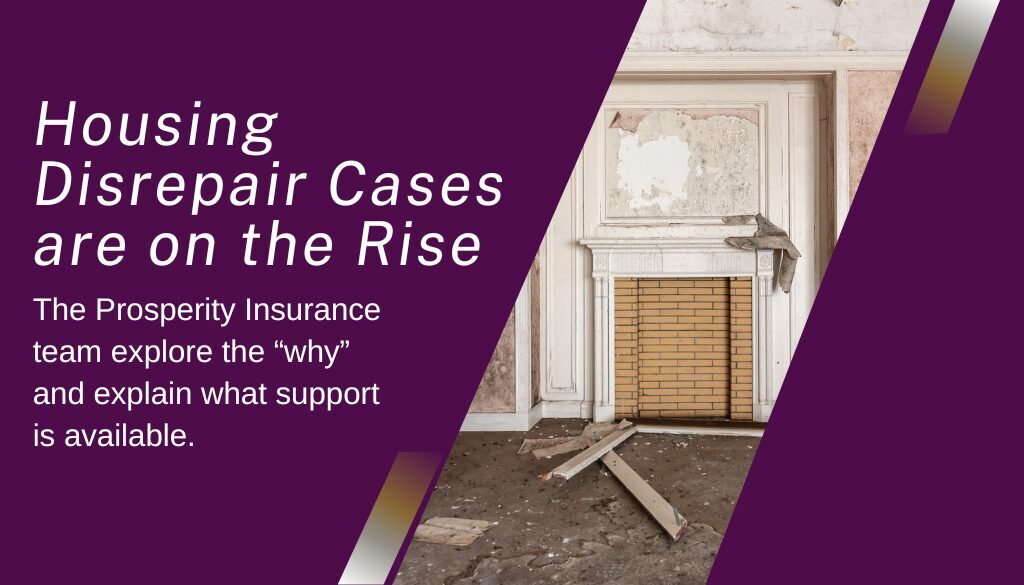
Social Landlords and Housing Disrepair – Why Cases Are Rising And The Support Available Why ATE Insurance Helps Improve Access to Justice.
The Housing Ombudsman’s latest Spotlight report on repairs and maintenance in social housing isn’t a happy read.
Despite almost £8.8 billion being spent on repairs and maintenance by social landlords in 2023/24 (that’s 60% more than in 2019) complaints about poor living conditions have risen dramatically. The Ombudsman investigated 474% more complaints about poor living conditions in 2024/25 compared to 2019/20, with poor practice found in 72% of cases. Repairs and maintenance now account for 45% of all complaints investigated, with 43% of those cases assessed as high risk [1].
For tenants living in these conditions – often for months or years – the length of process to get issues rectified can also have real consequences. Repairs deferred, appointments missed, complaints dismissed. The Ombudsman ordered over £3.4 million in compensation following investigations into poor conditions in 2024/25 alone and issued more than 12,000 orders to put things right. In 73% of severe maladministration findings – repairs and maintenance were the central issue [2].
The most common complaints
The Ombudsman’s report reveals clear patterns in the types of repairs complaints that most frequently lead to findings against landlords. Leaks, damp, and mould top the list – with maladministration found in 81% of relevant cases [3].
Beyond damp and mould, complaints often involve structural issues, heating failures, and problems with communal areas – particularly in larger landlords managing stock of 10,000 units or more. The report also highlights repeated failings around hazard management, with some landlords deferring essential repairs for major works programmes that are years away, or providing residents with DIY mould removal kits rather than addressing the root cause.
Disabled residents and those with health conditions are disproportionately affected. The report notes that only 19.5% of residents felt their landlord made reasonable adjustments – a figure that reflects systemic failures to account for individual circumstances when planning and carrying out repairs.
This is the latest step in Prosperity’s ongoing commitment to making indemnity insurance as accessible and easy to manage as possible. We know that for busy conveyancing teams, every extra click and every additional login adds friction – and friction slows down transactions. Integrations like this one are designed to remove that friction entirely.
What can residents do?
For many tenants, making a formal complaint through their landlord’s internal process (and, if necessary, escalating to the Housing Ombudsman) is the right first step. But where a landlord continues to fail in its obligations, legal action may be the only route to resolution. That’s where specialist legal representation can make a real difference. And it’s where the availability of Housing Disrepair After the Event (ATE) insurance becomes critical.
Prosperity’s housing disrepair ATE policies are designed specifically for cases against social landlords – whether a housing association or a local authority. They exist to remove the financial barrier that might otherwise prevent a tenant from pursuing a legitimate claim, and to protect the legal firms representing them.
Our policies
There are a few features that set Prosperity’s policies apart.
Three stage premiums – rather than a single premium for the duration of a case, Prosperity’s three-stage structure means the costs are often more manageable at the outset – and among the most competitive on the market. Critically, solicitors registered with the Prosperity portal can raise a premium at any stage of a case, giving legal teams flexibility to respond to how a matter develops.
No minimum volume commitment – Prosperity imposes no minimum volume commitment on the legal firms using its policies. That means firms of all sizes, whether a sole practitioner or larger practice, can access cover for their clients when they need it, without being locked into a minimum requirement. No fuss, no threshold to meet.
Fast and convenient – for firms registered with Prosperity’s online portal, a quote takes seconds and a policy can be in place within minutes. The portal has been designed with the pace of legal work in mind, with minimal reporting requirements to keep the focus on what matters: representing clients effectively.
For firms regularly handling housing disrepair work against social landlords, these features matter, because they result in policies that require little time to manage. This means more time to be spent on clients – not paperwork.
To find out more about Prosperity’s housing disrepair ATE insurance, or to register your firm for portal access, get in touch with the team today or email mark.rayner@prosperityinsurance.co.uk.

